
'When the national anthem of India was sung and joined by all present with the PM in front, it was the best moment of the whole night.'

Seeking to seize "transformative moment" in ties with India, US Secretary of State John Kerry will arrive in New Delhi on Wednesday for talks on key issues with the new Indian leadership.

Instead, increases in foreign-direct-investment levels; and reforms to make labour, land and capital more mobile.

Leading think tank discusses a likely Narendra Modi government and America's engagement with the man US once scorned. Aziz Haniffa reports

'The American fear of the Chinese military is overblown. The countries that should be concerned are China's neighbours,' Jeffrey Wasserstrom tells Rahul Jacob.

The American efforts to make India a security partner have enhanced India's importance to Chinese decision makers and new recognition of India's importance and achievements are reflected in a much more positive reporting about India in the State-controlled media, says Walter Andersen.

'Freedom of expression is not a freedom to abuse those who do not agree with you.' 'It is also about being liberated from prejudices and intolerance.' 'To me, freedom is the right to be who I am and what I am without hurting the same rights of others.'

As the context of Panchsheel has changed, it is all the more essential that India and China need to reinvent and redefine Panchsheel for a new world order taking into account globalisation, and mutual economic interdependence. The new Panchsheel, in order to be relevant, needs to shed its binary approach of west verses the east recognising the seamlessness of global frontiers, which globalisation has brought in, says Rup Narayan Das.

'Building on the potential for closer ties is the changing narrative in each country about the other. The Chinese narrative on India has become significantly more positive over the past few years,' says Walter Andersen and Zhong Zhenming.

'China's excessive military aid to Pakistan is the real elephant in the room as far as Sino-Indian relations are concerned. India should be confident enough to accept a degree of closeness between China and Pakistan, since China may wish to use this link for its foray into the Muslim world.' 'But the Chinese must be realistic enough to know that as time passes, the tactic of using Pakistan as a proxy to check India will yield diminishing returns. The US tried it for 60 years but failed, so will China,' says Colonel Anil A Athale (retd).

Finance Minister Arun Jaitley presented the Union Budget.

IT industry hiring big time, but quality concern persists.
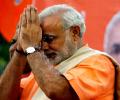
The Obama administration sees India not only as a land of huge potential for expanded business and trade but also as a strategic partner in the face of an increasingly assertive China, whose leader visited Modi in India last week.
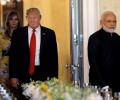
'China was the elephant in the Oval Office and Trump would have sensed that Modi's foreign policy architecture has become disoriented sans the US' pivot to Asia,' points out Ambassador M K Bhadrakumar.

India on Monday got the backing of Switzerland in its bid to become a member of the Nuclear Suppliers Group.
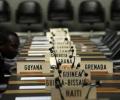
The differences between the rich and developing nations have always been at the core of the World Trade Organisation, set up in 1995 to facilitate greater trade flows across the world, and it came as a major breakthrough when the US and India reached a deal over food security issues in 2014.

'Progress demands regular senior-level attention from American leaders.' 'A leaders' summit is great, but we need sustained engagement to continue to forge new agreements and find new areas of cooperation.'

Prime Minister Manmohan Singh and United States President Barack Obama will meet in Washington on Thursday to chart a course for "future cooperation" in areas such as civil nuclear technology, trade, investment, defence and counter-terrorism, amid perceptions that bilateral strategic ties have plateaued.

The moderator, at times, had a tough time in controlling Kaine and Pence.

Nisha Agarwal, commissioner of the New York Mayor's Office of Immigrant Affairs, recalls, with both anguish and elation, the events of the last fortnight after the US President's order banning entry for people from seven countries was put in place.

'We're going to see a defence relationship that really takes off -- now that India is a major defence partner of the US, the sky is the limit for arms sales.' 'The economic partnership will lag behind the security relationship, but the meeting and joint statement give cause to believe that it will progress more robustly than many of us would have expected.'

'Naik is an outcome of an image-centric Islam, which is linked to the technological changes introduced by new media.' 'English educated upper middle class Muslims embraced Naik's image-centric Islam in the 1990s.' 'Television converted him into a religious object.'

The people who know Tibet will continue to fight the good fight. Long, hard, less than hopeful, but always peaceful.

Diplomats agree that amid stormy relations with China and Pakistan, Modi has posted impressive foreign policy successes, notes Aditi Phadnis.

'Those who follow the workings of the establishment believe that Indian diplomacy has managed more by the individual flair and brilliance of a few individuals than its systemic strength or organisational excellence.'

The referendum will have long-term implications for Indian companies, which earn a substantial portion of revenue from the region.

As football fans arrive to watch Euro 2016, France's trade unions have undertaken a series of strikes to provoke a make-or-break situation. Claude Arpi encounters both Gallic beauty and ugliness in the country of his birth.

Do Modi's foreign visits actually serve India or they nothing more than expensive tools for domestic positioning and image-building, asks Shehzad Poonawalla.

'While military acts such as the Uri surgical strikes are one option, cultural, economic and diplomatic isolation should also be part of the arsenal,' argues Sankrant Sanu.

Days before Narendra Modi arrives in the US to speak at the UN, meet Barack Obama, gupshup with the likes of Nadella, Pichai, Zuckerberg, and address desis in Silicon Valley, his ministers will help set the commercial and strategic tone for the prime minister's visit.

US Congresswoman Tulsi Gabbard, newly elected co-chair of the influential Congressional Caucus on India and Indian-Americans, discusses her vision for US-India ties with Rediff.com's Monali Sarkar.
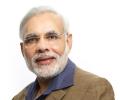
The major driver of Mod's foreign policy can be gauged from his economic priorities such as creating employment opportunities for the youth bulge. Related to this is emphasis on manufacturing, and infrastructure development, which in turn raises the issue of FDI. He has already articulated his views on all these issues, says Rup Narayan Das.

'The military in Pakistan is capable and self critical, but intelligence is stuffed full of lifers who resist change, which is why career soldiers in Pakistan try with all their might not to be transferred into the ISI.'

'India is no longer the India of the '70s and the '80s.' 'It's a large country with the fastest growing economy.' 'In working with India, you just can't go and humiliate the nation publicly.' USIBC President Mukesh Aghi tells Aziz Haniffa/Rediff.com about how he advises American companies to do business with India, what he thinks of Modi's government and the way forward for the India-US relationship.

'Tying somebody to the jeep is not the military way, but the officer was able to come out of the situation without any bloodshed.' 'I am not supporting him, but I am also not criticising him.' 'He had to use some mechanism to save the uniformed personnel, many of whom were Kashmiri boys of the J&K police,' points out Lieutenant General D B Shekatkar (retd), who was instrumental in the surrender of a record 1,267 terrorists in Kashmir.

'The Modi government's lurch toward America has not brought it any dividends so far. The Western world is simply not in a position to make big investments in India... India needs to take a leap of faith vis-a-vis China.'

'It is in the interest of both sides that the visit of the US President is seen as being successful. Both sides have invested considerable political capital in it. This rapid exchange of visits and the decisions taken have to be justified, beyond the symbolism, which is no doubt important in itself. This opportunity to impart a fresh momentum to ties should not be missed,' says former foreign secretary Kanwal Sibal.

Seeking a peaceful and secure neighbourhood amidst threat of terrorism and extremism, India and Kyrgyzstan on Sunday signed four agreements including one on bolstering defence cooperation and holding annual joint military exercises.

A young IT grad jailed for visa fraud committed by his agent, gives an insider's view of life in jail.
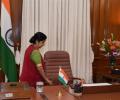
Sushma Swaraj, like Clinton, has a strong political base in her own party and is likely to have her imprint on foreign policy, says Ambassador T P Sreenivasan.
